Sunday, February 20, 2011

J Kuivenhoven Chapter One

The underlying idea for the reading was how art can be discussed formally in critiques. The authors discuss just about every aspect related to painting in the handbook. Towards the end of chapter one the authors go into all the different aspects related to sculpture.

The handbook is very through going into every detail you could possibly need to know when discussing art during a critique. The approach is given in a way that someone who knows a little bit about art would feel comfortable reading this handbook. While on the other hand a beginner would become a little bit lost on some of the terms not fully explained. An advanced artist would find the information redundant and elementary in approach.

The section praise and complaints is a good example of what conversations in a critique can be like. They are also great examples of how to loose friends and could be modified in order to build the thick skin a more advanced artist has built up over time. It feels like the handbook is geared for the beginner artist meaning that some of the advice they give is not appropriate for the level in my view.

Mostly the handbook sticks to the formal elements of art and how to critique a painting. Only near the end of the first chapter does the authors talk about how to critique a sculpture. They do mention some interesting aspects of sculpture that don't seem to really related with the rest of the handbook. Some of these selections include steel rods, glue, and room within a room. The room within a room is probably just a term that doesn't get applied much here at SJSU.

As far as questions go for the handbook reading, none have popped up so far. I am quite familiar with all that has been said in the handbook. Yet, it was nice to re-read all those art elements if only to be re-reminded of them. My favorite section of the handbook was about including the pedestal as part of the art piece which is a challenge I am currently facing for my BFA show next month.

My work is content driven so the handbook has not given me a whole lot to go off on as far as idea go. I like to think that I would keep all of these key elements in mind when I do create my sculptures. But the handbook has not been the cause of inspiration so for for my work.

Nichole's reading assignment 1

To approach a critique with the preset knowledge of formal standards, would be to diminish the meaning of the art work. We can use this knowledge of "shape, color, spatial relations, and materiality" to assume, but we must think deeper. There is an inherent sense to the art making process. The process starts with an idea, and thus this idea is carried out. There are many ways to perceive a work of art, as there also are many different art works to perceive. The ability to understand artwork formally is helpful, yet a sense of modernism, is understanding the "essence" of the work and process, brings us into the current times of art.
Art in the contemporary world has come afar from the past decades. The challenge to be a realist, is no longer a necessity, though considered a praiseworthy skill. Abstraction and representation have broke the most simple criteria to past artworks, though this criteria is the basis of the evolving of art. For instance, sculpture, can be viewed in multiple ways. First off, there are many different types of sculpture. Singular, multiples,expanding, room encompassing, suspended or propped- the list continues. Then there is the material, size, process, appearance, content, concept, space it resides, orientation, and more. All these elements are chosen by the artist.
The artist makes a choice to work a certain way to satisfy their idea. When created, the artwork stands in a certain way that hopefully creates a response in the viewer. When we critique a work we must take all these elements into consideration. The formal elements of artwork no longer suffice the proper dialogue to a critique. We must find reason in all elements, and determine or assume there meaning. Our assumptions may be based on our association with the piece, and thus brings up the point that we may view art work in a subjective manner. I find this subjective manner to be natural, in that we can only challenge our thoughts by what we already know. This is when the advantage of critiquing in a group of multiple individuals is important. The combination of minds is a powerful asset to human existence, and especially in the education system, to share our thoughts and knowledge in these situations.
The reading gave me a sense of what is possible in sculpture, reminding me of the multiple ways to pursue a piece of work. I do feel as though I am struggling with ideas for a 2nd project, in that the materials and methods we are using are somewhat new to me. I feel that once I finish my first project, I will feel much more liberated to begin thoughts on the 2nd project. For my first project I have now thought of the importance of how I will hang my piece. This work with either be suspended, or propped. Either way it will hold a place above the horizon line. I must think of the best way to present it.

Yes.

Yes, the first student post is in the right place and done the right way. Thanks!

Marek's Reading Responses

I sure hope this is the right place!

Reading 1: Critique Handbook, Chapter 1

This reading discussed the basics of how to critique pretty much any work of art in an all-encompassing way. Paramount to the reading of objects is the intent of the artist- with the advent of abstract forms of expression that modernism brought and the explosion of new ideas and forms of post modernism, art can no longer be critiqued under a single rubric, the way that salon painting was in the 19th century. The reading focuses then not so much on how to judge a work based on criteria of quality, but to examine how a work will be read, and what are some of the fruitful and barren approaches for interpreting a work.

The basics of formal elements for painting and sculpture are discussed in significant depth. With regards to painting, not only are the more commonly discussed formal elements of 2d design noted (line, color, composition, etc) but elements more specific to painting are explored in depth- how the painting relates to the edges of the canvas, how the picture plane occupies space and how to tell when that occupation is meant to be a significant aspect of the work as opposed to an ignorable necessity, how a painting acts as not only an artifact but also as a memento of its own creation (and how an experienced viewer can plot the course of the painting's creation, and divine the mental state of the artist as they made the work), the scale of the work, and when to read a painting as a representation (mimesis) as opposed to a presentation (referent to itself).

For sculpture, similar elements are discussed- the silhouette of a work, how it appears from different angles, whether it has a clear front or back, the footprint of the work, how it breaks up the space and effects how the viewers can move around it, how it relates to gravity (especially when suspended), how the work is presented (pedestals and room-within-a-rooms, ala the frames of a painting) and when the presentation methods should be seen as a part of the work or simply as a practicality, the materials and processes that a work is created in and with, respectively, and when the material has been used to create an illusion of something else or is a referent to itself (similar to the representational / non-representational divide of painting), and others such concerns.

The reading hasn't inspired me per se yet, although I've only just finished it and haven't had a chance to digest it, but the knowledge of these concerns is always interesting to think about when brainstorming, and just having the vocabulary to think and talk about certain elements of a work makes a significant difference with where your attention will end up. I took Art 12- 2D concepts last semester and it was my first introduction to the formal elements of painting- I'd never had it broken down in such a clean and understandable way before, and since that class I'd been wondering about what the equivalents would be in other mediums- this reading finally sheds some light, for me, onto those analogues in spatial art.

Invites

Hi All. If you get duplicate invites to the blog, ignore them, I just re-invited the entire class to make sure nobody got missed before.
Thanks
Shannon

Saturday, February 12, 2011

The Fine Art of Recycling


Really great sculptures made out of recycled material.

http://www.ndigallery.com/


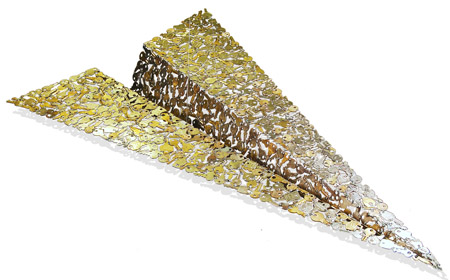
The first one of keys on a paper airplane is by Brian Mock.

The second one of metal parts to make a giraffe is by Andrew Chase.

And the last one, one of my favorite assembling artists, is Leo Sewell. He uses a lot of random, founded junk to create his sculptures.


There's a list of artists within the website with some truly amazing pieces. They may not exactly be using materials for the kind of projects we'll be doing, but they may provide some great inspiration/ideas :)


*Update

Mark Langan would be a good one to look at for his artwork using cardboard.

Sunday, January 30, 2011

OMG!

Absolutely, add Chris Burden to your list of artists to write about. His new work is mind-boggling. You must watch the video.