Monday, February 28, 2011

Y Tanaka - The Story It Tells

When we look at a piece of art, we first examine formal choices made by the artist, such as materials, surface treatment/gesture (brush strokes, etc), composition, color, texture, scale, position and how it’s made (process). Then we try to understand why the artist made such choices, as well as the artist’s intension. To get to that point, it’s important to know what “meaning” is and how it’s embedded in a work of art.

“Meanings” are not absolute as we live in a society, which is changing politically, socioeconomically, environmentally, technologically, historically, personally, etc., in flux, therefore meanings change, too. “Signification” is interpreting its meaning and it’s embedded in a complicated world. It depends on who is speaking, where they are, who is being addressed, how the message is delivered, and what the circumstances are, etc. When we look at a piece of art, we first notice what we can see obviously (“denote”), then how we can read it or make sense out of it (“connote”). “Content” and “subject matter” are different. For example, subject matter is denotative and content connotative. Furthermore, how the work was done (process) is a determining factor for content or meaning, and not what was created (subject matter). The work can also be read/interpreted according to how the work is presented by the artist - “descriptively” or “prescriptively”.

Sometimes the subject matter weights more than the content unintentionally by the artist when the subject matter is so strong, such as gender, race, sexuality, ethnicity, handicap, etc. That could lead to an incorrect interpretation of art by the viewer. “Who tells the story” also has a major impact on the content. The identify of the artist, such as gender, ethnicity, culture can influence the meaning of art. Objectifying other person (people) as the subject can make things complicated even further and it may not reveal the artist’s meaning as it was intended. The new way of viewing the art in such perspective has derived from the fact that the rise of feminism in the late 1960s and early 1970s and discoveries of “non-Western” artists. Who behind the work became very critical as to analyzing the work of art. It shouldn’t be the focal point, yet without it, art may not be complete.

When looking at a work of art, we immediately notice an element that stands out the most. In other words, it’s been foregrounded. Then we begin investigation of the art further by careful examination of each formal element, such as form, color (refers to certain emotion, symbol, index), pattern, palette, a theatre (placement), configurations, composition, gesture (act of art making), material, process, etc which will land to a meaning.

To understand the meaning of art is complex. We must consider not only what’s visible but also what’s behind the work as well as who is the maker. I do agree that it’s important to know who the artist is, what’s his/her background is, what/who influenced the artist, and any other factors or life related to the artist as detail as possible in order to fully understand the intention/meaning of the particular art, therefore, provide a good and constructive criticism.

Monday, February 21, 2011

Jan Michael Cruz: Blog One

When looking at art, a myriad of actions process in our minds. We see its color, its shape; the immediate natural responses take place. The reading refers to a pieces’ form and content line, wherein lies the art. Where is the work placed, on the form end of the line, or the content end? That’s were the critique begins, or ends. I better understood this through the red rectangle example. Untitled #3 vs. After the Massacre. We see the large painted rectangle as two different things when a simple thing as a title is given. But other factors can alter ones view on the painting, for example if the painting was painted with actual blood, compared to the same painting done with acrylic paint. Perhaps the “untitled #3” was painted with pig blood, and “slaughterhouse” was painted with oil. The content-and-form line where the “art” gets placed is suddenly in a pickle.

The reading mentions Anthony Caro and him commenting on the period of time where it was difficult to create a sculpture that did not remind him of something else. Caro must have seen a lot of work. He proposed a problem, and through what the reading explains, the work to be evaluated had to be done so formally, understanding and seeing the piece as a whole, by means of its shape, color, parts, material and weight. A pillow for example is soft, reminds one of sleep. But take the very same pillow, but create it in carved stone, suddenly the pieces’ content changes. Do I think of the difficulties some face when sleeping? Or is this an artist’s rendition of a caveman’s sleeping accessory?

A discrete object in space, where a sculpture is a work consisting of a singular object, or a work expressed by multiple parts, are both read as a single form. How this form gets shown in a gallery is something of another feat. Taking a work and placing it on a pedestal is one way. Incorporating a pedestal to that same piece, whether it be made of the same material, or follow lines already occurring in the artwork and be constructed independently in another material will definitely cause the viewer to have more thought in what he or she has to say about the work. Instead of the art having a footprint consisting of the pedestal it rests on, the art could be larger (or smaller) depending how the pedestal is incorporated into the work. The pedestal could then be considered part of the art, rather than being the slave the work uses to be shown off to.

This reading proposes new ideas and ways of thought that are new to me. Applying the concepts into my own ways and reasoning when I go out and view and critique others artists’ work will definitely be an new experience.

sara gevurtz' blog 1

While reading the first two chapters of The Critique Handbook, I was reminded of one of the first things I learned as an undergrad in the very first art class I took: you have to think about everything you do in art, and have a reason for it. As I have matured as an artist, I have run into many critiques where I will be asked why I used one material versus another. This especially has become problematic for my paintings. The first chapter discusses painting, and how for many painters they have simply accepted the rectangular canvas as a “neutral ground on which to hang a painting.” (page 13) The next section starts to ask various questions about the logic of painting. How big the work, is it painted on a canvas or on something else. As an aside, while reading this I remembered a conversation I had about one of my paintings I did my first year of grad school. I had painted a pile of burning bottles on a large canvas in oil. The scene was from Afghanistan, and was taken by my friend in the army. It was showing where the army dumps the hundreds of thousands of plastic water bottles that the American soldiers stationed there go through. A question I received about it was why did I paint it on a canvas? Wouldn’t it have more meaning if it were painted on say, an army backpack? The form and the meaning of a piece of work are often tied together, and the book discusses.

The first chapter covers form in terms of painting and sculpture. It raises various thoughts about looking at a painting, and how the artist approaches the painting, representational versus abstract, etc. When discussing the sculptural object, there is a section that discusses the problems of presentation. Canvases are hung on the wall, and framing or not framing, leaving the sides exposed or not exposed all come into question for a painting. However, with sculpture, the problem of how to present them within the room, and how to deal with elevating them or not elevating them on a pedestal comes into play. Does the pedestal create a discussing with the art, or disappear into the background? Should the piece stand on its own? Should it hang from the ceiling? All of these issues create dialogue with the piece and can change the meaning.

In the second chapter of the book, it discusses meaning. Meaning is never exactly fixed and can be open to interpretation. Meaning is molded by the choices that the artist places in the art from content, form, materials, etc. It also discusses how similar content can have different meaning if presented in different forms.

As an artist it is hard to anticipate how all your choices about what to include will affect your audience. People will often get different meaning from the same object. The section discussing the pedestal got me thinking about my current project that I am working on. I have yet to resolve the issue of what I will place one of the major components of the project. The part of the project that needs to be propped on something is a map of California that will most likely be made out of vacuform plastic. The problem is no matter what I place it on; it needs to be functional and yet not distracting. It was a lot simpler when I stuck with works on paper or canvas, since as the book point out; they are often just taken on face value and not overly questioned.

Athena Chow, Response #numero Uno

As students, artists, and viewers alike, I think we tend to subconsciously critique art pieces in the order of form first, and then content. Our perception of artwork is first form, because form, as described by Kendall and Paula, is the elements we naturally observe when first encounter an art or design piece: shape, size, color, scale, composition, etc. Our visual impression, is then followed usually by a curiosity for wanting to understand the piece better. When we search for content, we are usually looking for some sort of narrative, information, or deeper meaning behind the piece that could be alluding from the piece’s title or even from the form itself—this is called formalism, as noted by The Critique Handbook.

As I further read the handbook, I learned that many aspects should be taken into account for when giving a critique. Is the artwork based off of accurate realism? Or of abstraction that includes some reality to it and yet also some distorted imagination? Is the artwork an object representing a mimesis-- an imitation-- of another object or experience? Is this a nonrepresentational piece with no real underlying structure from our reality? What kind of lines are drawn—soft, hard, contour-like, scribbly, straight, accidental, or intended? Do the colors give me a certain elated emotion when looked upon? Or are they clashing and giving me a sense of anxiousness? Does the framing, format, and edges of the piece help add to the content or visual aesthetic intended by the artist? Do I see a correlative message that pertains to the idea of something political, historical, personal, fictional, or perhaps, even nothing at all? Do I associate this piece with something I’ve seen or experienced before? On what scale is the piece being displayed? Is the piece carrying some miniscule, tentative details that needs to be scrupulously observed over? Or is the piece made part of a room, an installation, that is causing me as a viewer, to take part in a magnified sensory experience? What materials and process did the artist use to arrive to his or her final masterpiece? Wood, cardboard, plastic, paint, found material, tape, glue? Were special adjustments needed to assemble the work, such as prop-ups and pedestals, to give the illusion of suspension and gravity?

After reading the first chapter of The Critique Handbook by Kendall Buster and Paula Crawford, I felt like I was more formally informed on the technicalities of critiquing. When I first read Kendall and Paula's introduction of how critiques tend to be given with the formal ‘praiseworthy’ and ‘complaining’ sort of comments-- a made example of this could be, "This ceramic elephant has superb detailed-craftsmanship in its meticulously painted colors and patterns, but I think its sculpted ears and hind legs could have been made a bit more proportional."--I kind of smiled to myself about this. First, because this typical way of critiquing rang so true, and secondly, because I had never really given thought to the formal dissection of a critique-- I found it interesting to learn about the formal terminology and many little aspects that encompassed proper critiquing. As a 3rd-year art and design student who has participated in many classes and critiques herself, I found The Critique Handbook to be quite helpful and interesting, especially in the areas of certain critiquing details that I had not known before. I definitely feel like some of the terms within the handbook could help me express my next critique more intellectually and succinctly.

Kendall and Paula overall, did an excellent job on elaborating and giving an in-depth overview of the various aspects that could be analyzed within a critique.

Cody M. reading responses

Reading Response 4

 Titling a piece is a very powerful move, but it is often a necessary to convey the true message of a piece. The example of the red square is used over and over again in the reading. The same subject matter has different meaning because of the subject that is supposed to represent. The first example is of the Israelites crossing the red sea, or having crossed the sea, with the Egyptians being swallowed up behind them…this is represented by a red cube, representative of the mood of the piece, of anger, triumph, and even pain. The red cube is also described as being representative of a psychological mood, and another is a landscape from Moscow, titled red square.  The entire point of this passage to tell us that these nearly identical pieces, have very different subject matter, and corresponding titles. In the reading, it is later talked about an artist creating a piece of work which is untitled and has no description.  The reading examines this…what weight does this piece have with no story and no title? My issue is that art can be worthwhile without these things. Artwork can be aesthetically correct, or beautiful. If this red square was examined, and it showed that it was of some perfect proportion, of that is was a particularly beautiful hue of red, it would be just as important as another red square that has a title and a meaning. Who knows, maybe the fact that a particular red square having no title and meaning adds to its mysteriousness and forces people to try and go deeper into thought beyond what the artist had thought of.
In the next section, where the raising of Jesus’ hand is examined for deeper meaning. Is
His hand raised, has it just been raised, the fact that it is raised means that it is not lowered, is it a bodily movment or is it being purposefully raised by its owner. I feel that anyone who reads this passage will be much better equipped to answer the question, which came first, the chicken or the egg; or maybe they people who read this in the first place are already adept enough to answer that question.
The next section for me was confusing. This passage about a mirror was difficult for me to understand, but I do agree with the writers final statement, that the artist J has convinced me that this mirror, a mere a object (haha, a mere mirror) is somehow a piece of art.

 Reading Response 3

I found the writing on page 5 talking about how artist are the dreamers and dreamers particularly powerful. “Artists and poets landed on the moon long before any astronaut did, travelled through space and time, teletransported, practiced non-invasive medicine, and almost everything else one can think of before they were invented.”  This is a very true statement! The job of the artist is to be imaginative, to think of what has not been done, and how to do it differently. To be an artist, one must also be a mathematician, a story teller, a chemist, a designer, a philosopher, a craftsman, and anything else in-between. The limitation of the artist then becomes what the artist is experienced with in terms of materials and media.
As a sculptor, I have a certain amount of control over the piece I am making, but eventually there is a point where the piece I am working on no longer resembles the initial idea I had. This is because of limitations in the particular media I am working with, or new ideas I have had to make the piece better. An interesting point the writing makes is that art today is more of a political message, or that the art is based on conveying a message versus showing innovation based on art form. I agree with this to an extent…just like in the past, when there were innovations in figure drawings, still life’s and landscapes, there are still innovations today that still have artistic relevance. Using new tools and methods such as CNC based sculpting techniques, new materials such as carbon fiber to make ultra lightweight sculpture, or using computers and printers to produce exact pieces of art still have merit. They do not need to have a message to be art. That being said, we are reaching a point where so many different uses for media have been explored that to have new different art, one must have a powerful different message.  Duchamp turned the art world upside down with his ‘fountain’, making all art conceptual…when will see another Duchamp who will change the art world again and give us new ideas and possibilities to explore?

 Reading Response 2

Once again, the critique handbook! Oddly enough to me, I found some parts of this chapter particularly insightful. Chapter 2 is all really about meaning…how variations may change a piece of arts significance and/or meaning. This can be very important, because it takes artwork beyond just being aesthetically pleasing to something that has cultural significance. A particularly insightful part of the text I found was the section dealing with religion, titled “the Loaded Message.” In this section of the reading, It is discussed about how many pieces of art, which may not be correct (not having correctly proportioned figures, or using awkward color combinations) will be praised or even cherished because of the religious figure or message depicted. In my own opinion, so of my favorites of these are depictions of the Christ child with his mother from the Dark ages. Baby Jesus in these paintings looks more like a giant monster that will grow to be a 9ft tall behemoth. Early artist were able to get away with this because of the religious message of the painting, and In my opinion, no one wanted to talk down a religious painting, even if it was incorrect. I understand that some artwork has meaning but I feel that this ability to attach meaning to artwork has caused abuse of meaning. I have a joke of whenever a person asks what message I was trying to convey with my artwork, I reply with that this piece is a reflection of our counties lack of motivation to provide aid to countries that we have been ravaging for decades. I usually say this as a joke, but I have seen this in a lot of galleries on and off campus, and it is my opinion that people are becoming too attached to the meaning of their artwork. Just like it is written in the critique hand book, many people can use the color red as their primary card swath, and will be able to have their artwork as being angry because of the color choice. My question is simply, what happened to the artwork made simply to have good artwork? Not all art has to has a ridiculous meaning attached to it (either by the artist or the audience) Art as a whole needs to go back to its roots to when art was just about form…although, that would be kinda impossible. Art has been a way of story telling and teaching the different meanings of life for thousands of years. Maybe meaning isn’t such a useless pain…although if someone asks me why I chose to use plastic for a particular project and asks if it is a critique on our dependence on foreign oil, I might just scream!

Reading Response 1

The reading was mostly about how to, not so much critique artwork, but how to analyze artwork from all angles. We were asked as critique-ers to think about not only the finished product but to also consider the process that the material went through from raw to finish. We were also asked to use this knowledge of material and the construction/deconstruction process to see how the message of the artwork changes.

We also found that the meaning of artwork can change immensely simply with a change
in the title. Although obvious, I found the passage on page 4 especially helpful . This passage, which discusses a hypothetical monochrome red painting initially is untitled, making it a color study and not much else. However, this piece is greatly changed when it is titled something like “after the massacre” changing this piece to a reflection of a probable real world event. My own interpretation of this would be a painting with unknown title of rugged sailors/pirates from the 1700’s stealing cargo. If one were to rename it “Tea Party” the viewer would immediately know this is a reference to the Boston tea party of colonial America. In addition, the more historically savvy viewers would then try to find certain famous revolutionaries in the painting making it all the more successful.

The rest of the reading was pretty straight forward. Like I said, we were asked to consider all the different aspects of the art pic, from typs of material for construction, through tools used in that construction process, to the finishing polish or color on the piece. A large portion of this reading simply summarized these different processes.

I didn’t quite agree with the reading completely however. I felt that the writers(s) really focused on the narrative of the finished art piece. The authors want us to analyze how the material, title, context, ect, effect the meaning of the art piece. My question is: “why cant art just be compositionaly good, and just that?” How do you attach a narrative to an untitled paint splatter by Jackson Pollock? Wouldn’t some deeper meaning potentially degrade the quality of the artwork? My point that I am trying to make is that sometimes a great piece of art doesn’t not need a narrative and that an attached narrative will cause the human mind to attach both obvious and subconscious meaning to a piece, thus changing the value of the piece between each viewer.

My only other criticism of the reading is the fact that on numerous occasions, the authors made conclusions so complex and full of art jargon that the sentence almost became unreadable. This was so bad that at almost every one of these encounters, the writers then restated their position, often starting with the term “in other words” and stating a simple and easy enough sentence to understand. From a pure writing standpoint, this made the reading exceptionally tedious.

Wilson - Reading Assignments

Cragg - Cutting Things Up


Critique Handbook - Chapter 1

The handbook shows us how to critique an artwork and show what questions to ask when critiquing.

Many people think that form is the container that holds the content for an artwork. In its simplest term, form is the mean by which a person gives substance to their idea.

Form differs in sculptures and paintings. In a sculpture, the form of that sculpture is its weight, density, mass, proportion, and the three dimensional shape. In a painting, form is there in the painting's composition, texture, pallet, and line quality. In a sculpture, all it's form is made up of an infinite number of shapes.

In looking at a sculpture, we begin by looking the relation it has with the space it occupies. We have to ask where the sculpture ends and the space that it occupies end. This is important because the negative space in a sculpture is important. Even if the artist have not considered the space around their sculpture, the space around it is still important to look at.

The way a piece of sculpture is presented affects its form.

When a sculpture is suspended, it allows it to defy gravity. In a critique, we have to look at why it is suspended and what it suspending the sculpture. So the question of is suspension really necessary is raised. Is suspension the best choice for the sculpture or might it be better off freestanding? The materials used to suspend it is important also. If a heavy chain is used to suspend the sculpture, it becomes part of the sculpture.

When using a pedestal, the question is raised of where the artwork actually begins. The pedestal can be seen as a way to raise the sculpture to a person's eye level. The pedestal also affects how a person percieves the artwork. The height and where the pedestal affects the perception of a sculpture.

The way a sculpture is propped up can affect how a person views an artwork. The materials used to prop up the sculpture becomes part of the artwork. Do the prop ups look like it was done to be part of the sculpture or does it look like something done in the last minute?

From this reading, I'm starting to question if all the props of guns and swords I made are sculpture pieces. They are made for costumes and I usually take photographs of the props without the costumes. So do those props have the same meaning when they are away from their costumes, away from it's context? Or do they have enough meaning on their own to be a free standing piece of art?

Y Tanaka - Form Matters

When critiquing art works, we look at forms first whether it’s a painting, sculpture or other media. Forms can be the physical form of a sculpture, as well as formal elements, such as scale, shape, size, composition, and color. Formalism emphasizes these formal elements in art and art making process. It can hinder a narrative content but also be self-referential. The modernism changed the value of formalism. Visual elements were celebrated and embraced rather than a reference to create an image, which was the focal point for pre-Modernists. Abstraction is not self-referential because it doesn’t remind one of something else. On the other hand, realism is self-referential, which can be easily associated with characters or something familiar, therefore, it helps developing a story, just like how a novel works. However, the definition of realism is depending on how artists view “reality”.

When critiquing a painting, we should consider edges, line, color, composition, fields, scale, format, surface, gesture, and process. The painting is also an object, rather than surface. It can be a platform for a performance act. It is also a mechanism to deliver a narrative content. Critiquing sculptures are conducted in a similar fashion. The criteria includes, the object as well as discrete object spatial/compositional relationships, footprints, gravity, suspended pieces, pedestals, and prop-ups, ratio, the room spatial relationship, fields, the expanding, exploding, or meandering form, formal considerations within the object, mass and shape, material and process, construction, material/process as form, as action, and illusion and integrity of material. When an installation can take up an entire exhibition space, the installation piece becomes architecture. Material and process are a very integral part of the form, as well as developing a concept. For example, I constructed miniature trees, one made out of a thread, the other computer wires. I deliberately selected these materials, which I coiled one by one around tiny-trees. Both materials and the process support my concept, which depicts a technological transformation, nature versus man-made materials.

Kendall Buster and Paula Crawford often associate their content with music or writing practices, which I thought was fabulous. They said, “Greenberg argued for a kind of painting that refuses to be the carrier of a narrative, much the way a symphony is a complex structure whose emotional and expressive content relies purely on the structural relations set up by the composer. Color, line, repeated motifs are orchestrated across the surface of the canvas much the way melody, harmonic textures, and repeated motifs are arranged by the composer.” An individual visual element doesn’t mean much, just like a simple notation. But if it’s combined with one or more elements (e.g., one or more notations), it gives a meaning/life, just like creating a complex the structure/system or having an orchestra. Interesting comparison…… and yes, form matters.

Dan S. Reading response


Critique Handbook Chapter 1

This chapter of the book discusses the many potential elements of a work of art. Each characteristic is broken down and an example of how it might apply to a piece of art is given. There are also sections that discuss the relationship between certain elements and how these characteristics can help a piece of art convey its meaning to the viewer. The main focus is how to critique these attributes and is discussed along with possible questions that the viewers can ask themselves when examining art. Both spatial and pictorial works are discussed and some famous critics opinions are also included throughout the chapter. The main point this article brought to mind is the critique of an artwork as a whole. There can be many layers and meanings to a work and reading the chapter reminded me of the many distinctive components that a work can contain. This chapter covers quite a bit and all of it can be useful when examining a work of art.

While reading this chapter I started to think of how the application of form could be used with the material I am working with and how to manipulate the material in two ways: how to convey form without the material impacting that image and how to effectively use the material without changing its appearance. If I don’t come up with something satisfactory for either of these goals then I will probably focus on how to change the appearance of the materials.
The overall focus of this chapter to me was the relationship between the characteristics covered and how to go about discussing each part of a work in relation to the other parts. The sections that compared the potentially opposing traits in a work were interesting as they pointed out these may not be so different. There are other points that the article brought up in my mind. Abstraction and shape versus reality and how these two traits are influence on the final product. How to effectively convey meaning without sacrificing the intent or the goals behind the creation of a work. When creating a work that is not site-specific how often does the artist take into account the potential spaces that work might be placed in or displayed? How to effectively use a space to increase the understanding or meaning of work? How to make a spatial work that is strong enough to convey it’s meaning regardless of the space it is placed in? I don’t see this problem with pictorial works as they can be perceived as separate from the area they are placed in and can be placed in a frame that may or may not be used to enhance the message of the work.

kevin tam reaadddinggzzzz

The content of this handbook focuses on how to properly critique almost any type of art work. It discusses what a person needs to know when going into a critique and the ability to understand the artwork. When looking at a painting formally or a sculpture formally, you have think about what makes the painting a painting or what makes the sculpture a sculpture. It talks about if a real painting done on a canvas or could it be expanded on different mediums. It asks if a painting is the same whether it is done academically or done on the streets. How would one critique if the painting is a representation; does each stroke on a painting needs to be analyzed. The chapter also talks about when materials are chosen for an artwork, does it matter what materials are used; does paint have a better quality than a projection or a photograph. Also how would one critique an art when the painting is abstract compared to realistic; would one critique it the same or differently. The reading goes on talking about sculpture and whether if the pedestals, base of a sculpture, should be seen as an art. According to what a sculpture should be, then the pedestals should be considered part of the art since its part of the entire space. If the pedestal would be part of the art, the ratio of the pedestal to the surroundings must be considered. The use of a type of material can dramatically improve the artwork. When modeling, casting, and carving, you are adding or removing. The reading brings up many points that I feel could help me with my projects. Incorporating objects that would not normally be seen in art to form a sculpture. How could you use a plaster for its plasterness in an art? How would clay by itself be used to make something unique.

Melissa Asis . Reading Assignment 1 / Ch. 1

In this reading it talked about many things that people use to critique a work of art. There are many ways that an artist and/or student will say about another’s work and how to make it look better or how well it already looks well done. It goes into detail about how the mind works when thinking about a piece whether it is on paint and canvas, sculpture, or digital design. People critique a piece with what exactly is on their mind when thinking about how the artist went by making it. When a person looks at a piece and it has a name to it already then it helps the person critiquing it figure out what he/she is looking at but if there isn’t a name that goes with the piece then the person critiquing it will come out with something abstract. Abstraction itself is a broad term because it defines itself as being “nonrepresentational”. With a piece being nonrepresentational it gets a little more difficult to even critique something because there are a million questions and especially one being of “what exactly am I looking at?” This is where a person really needs to use logic and really question oneself of the design, colors, medium, and shape, and so on to come to a conclusion. Once we come to a conclusion and understanding of what was produce then we can look at what is represented in the piece and what form it brings on. The reading goes on about formalists and what is represented in the pieces and what qualities it brings. As it goes on about form and what it represents then it has us thinking about realism and how much the artist captured the piece from a realist point of view. It questions on how much detail was brought into the piece and is it enough to get what is trying to perceive.

I think this reading is to give us an idea of how to come across our classmates pieces and to look into detail how well the piece is made and how it was made. Instead of just looking at a piece and saying, “it looks good”, we need to give an explanation towards why it is a well made design and to ask as many questions as we can towards the students work. It also has me thinking of how to apply certain ideas from different points of views for whatever object or figure I work on and how to present it.

Not quite sure if what I want to do for my projects but I am working on trying to get something to work on.

L. Dubay Reading 1

This first chapter of The Critique Handbook discusses an array of ways to critique art. It focuses on the formal matters of how to critique and analyze art. It begins with form and content and then speculates about how analysis of a piece can triggers questions. The example given of a red painted rectangle with a simple title of “Red Rectangle” gives an entirely different message than the same piece titled “After the Massacre.” Which now makes me think about how an artist’s title of a piece influences me? The chapter then proceeds to discuss formal praise and complaints. The examples given seem to be standard critique where one says what they like about a piece then gives an example or suggestion on how it may be improved. The next sections are about formalism and modernism, and abstracting and abstraction. These two topics bring up questions that are answered in several points. If an abstraction of an image maintains its recognizable traits of an object or if it is just a reference to something real, which is abstraction or realism? This brings up the many questions on how to critique realism versus abstraction. If a piece is not as close to looking real as it possibly can be with the materials given, should it still be classified as realism or abstraction? It states that, what is real all depends on what the source is. Many artists learned their craft through looking at mirror or photographs. These visuals are flat references that are aiding flat images, so how real can realism get? Then the chapter talks about how associations need to be recognized in a critique. People need to see a likeness in a piece.

The chapter then goes on in detail of different elements of types of artworks. There is a part that discusses what the ingredients are for a painting to be categorized as a painting and if a painting is still a painting without some of the essential tools. It talks about edges and how they define the outer edge of a painting and where the pictorial space ends and the rest of the world begins. This reminds me of many paintings that have clean crisp edges that are obviously taped off on purpose. I have also seen several where the artist has a defined edge but intentionally meander past it and continues an element in the picture in that stark space. It then talks about how when people discuss composition of a piece they always speak of the formal analysis of the composition, which they were taught of in school. The chapter then goes on about elements of formal sculpture critique. There are many good specific examples of ideas expressed in this section. In this sculpture section there is information on what elements to think of on how to display sculptural pieces. The materials and process section discusses how, in sculpture, the material sometimes dictates the process or the process dictates what materials to use. Then it tells about how materials used to be used in one a few ways with a few processes, but now lots of different materials are being used in a variety of ways. The process of construction starts with a list of materials that can be used with a list of processes that can work with those materials.

blog01

What is art? Art is something which is hard to quantify. The readings doesn't answer what is art but focuses on the point of how to look at it and how it can be categorized into reconizable pieces. "Formal Matters" is just the beginning on how to think about critiquing art. The chapter begins with a discussion of form vs content in order to talk about composition. Is the composition tell a story or does its placement relate to formalist qualities?Does one have a greater value over the other? Will narrative be more important than the objects themselves? Without narrative do objects become formulaic, following formalist rules?

Does being able to paint, draw or sculpt with machine like accuracy make one a better artist? Does photo realistic renditions say more or less then a cartoon character? Technique an craftsmanship are appreciated in the arts but are they necessary? Where should the line be drawn?

“The challenge to be a realist, is no longer a necessity, though

considered a praiseworthy skill.”

- Nichole

I have to agree with Nicole on this point, with the invention of modern technology it becomes less and less important to imitate reality. With a camera it is possible to capture reality quicker then is possible with drawing. Harold Edgerton a photographer known for his stop action photos considered himself a scientist rather than an artist though many of his photographs are considered art. The benefits of art that I see is not in capturing reality but in creating the imaginary.

The section on realism got me thinking. What we say is real is based entirely on our perception so if we reverse it, what we cant not perceive is therefore not real. Taking this one step further, imagine a sculpture stored inside an ordinary box and the sculpture is something that will never be observed by an audience. Playing with the idea of reality in the mind of the viewer. To the viewer the sculpture does not exist since it can not be perceived.

Did the chicken come first or the egg? Do I make the work using these artistic elements or do I make the work relying on intuition to guide then later attributing artistic elements to it? Many of my ideas begin with a humorous narrative which I then abstract and simplify. It is my worry that by following a rigid set of theories my work will end up being formulaic and predictable.

Just wanted to say I never did this blogging thing before so not sure if I'm doing this right. ^_^


Sunday, February 20, 2011

J Kuivenhoven Chapter One

The underlying idea for the reading was how art can be discussed formally in critiques. The authors discuss just about every aspect related to painting in the handbook. Towards the end of chapter one the authors go into all the different aspects related to sculpture.

The handbook is very through going into every detail you could possibly need to know when discussing art during a critique. The approach is given in a way that someone who knows a little bit about art would feel comfortable reading this handbook. While on the other hand a beginner would become a little bit lost on some of the terms not fully explained. An advanced artist would find the information redundant and elementary in approach.

The section praise and complaints is a good example of what conversations in a critique can be like. They are also great examples of how to loose friends and could be modified in order to build the thick skin a more advanced artist has built up over time. It feels like the handbook is geared for the beginner artist meaning that some of the advice they give is not appropriate for the level in my view.

Mostly the handbook sticks to the formal elements of art and how to critique a painting. Only near the end of the first chapter does the authors talk about how to critique a sculpture. They do mention some interesting aspects of sculpture that don't seem to really related with the rest of the handbook. Some of these selections include steel rods, glue, and room within a room. The room within a room is probably just a term that doesn't get applied much here at SJSU.

As far as questions go for the handbook reading, none have popped up so far. I am quite familiar with all that has been said in the handbook. Yet, it was nice to re-read all those art elements if only to be re-reminded of them. My favorite section of the handbook was about including the pedestal as part of the art piece which is a challenge I am currently facing for my BFA show next month.

My work is content driven so the handbook has not given me a whole lot to go off on as far as idea go. I like to think that I would keep all of these key elements in mind when I do create my sculptures. But the handbook has not been the cause of inspiration so for for my work.

Nichole's reading assignment 1

To approach a critique with the preset knowledge of formal standards, would be to diminish the meaning of the art work. We can use this knowledge of "shape, color, spatial relations, and materiality" to assume, but we must think deeper. There is an inherent sense to the art making process. The process starts with an idea, and thus this idea is carried out. There are many ways to perceive a work of art, as there also are many different art works to perceive. The ability to understand artwork formally is helpful, yet a sense of modernism, is understanding the "essence" of the work and process, brings us into the current times of art.
Art in the contemporary world has come afar from the past decades. The challenge to be a realist, is no longer a necessity, though considered a praiseworthy skill. Abstraction and representation have broke the most simple criteria to past artworks, though this criteria is the basis of the evolving of art. For instance, sculpture, can be viewed in multiple ways. First off, there are many different types of sculpture. Singular, multiples,expanding, room encompassing, suspended or propped- the list continues. Then there is the material, size, process, appearance, content, concept, space it resides, orientation, and more. All these elements are chosen by the artist.
The artist makes a choice to work a certain way to satisfy their idea. When created, the artwork stands in a certain way that hopefully creates a response in the viewer. When we critique a work we must take all these elements into consideration. The formal elements of artwork no longer suffice the proper dialogue to a critique. We must find reason in all elements, and determine or assume there meaning. Our assumptions may be based on our association with the piece, and thus brings up the point that we may view art work in a subjective manner. I find this subjective manner to be natural, in that we can only challenge our thoughts by what we already know. This is when the advantage of critiquing in a group of multiple individuals is important. The combination of minds is a powerful asset to human existence, and especially in the education system, to share our thoughts and knowledge in these situations.
The reading gave me a sense of what is possible in sculpture, reminding me of the multiple ways to pursue a piece of work. I do feel as though I am struggling with ideas for a 2nd project, in that the materials and methods we are using are somewhat new to me. I feel that once I finish my first project, I will feel much more liberated to begin thoughts on the 2nd project. For my first project I have now thought of the importance of how I will hang my piece. This work with either be suspended, or propped. Either way it will hold a place above the horizon line. I must think of the best way to present it.

Yes.

Yes, the first student post is in the right place and done the right way. Thanks!

Marek's Reading Responses

I sure hope this is the right place!

Reading 1: Critique Handbook, Chapter 1

This reading discussed the basics of how to critique pretty much any work of art in an all-encompassing way. Paramount to the reading of objects is the intent of the artist- with the advent of abstract forms of expression that modernism brought and the explosion of new ideas and forms of post modernism, art can no longer be critiqued under a single rubric, the way that salon painting was in the 19th century. The reading focuses then not so much on how to judge a work based on criteria of quality, but to examine how a work will be read, and what are some of the fruitful and barren approaches for interpreting a work.

The basics of formal elements for painting and sculpture are discussed in significant depth. With regards to painting, not only are the more commonly discussed formal elements of 2d design noted (line, color, composition, etc) but elements more specific to painting are explored in depth- how the painting relates to the edges of the canvas, how the picture plane occupies space and how to tell when that occupation is meant to be a significant aspect of the work as opposed to an ignorable necessity, how a painting acts as not only an artifact but also as a memento of its own creation (and how an experienced viewer can plot the course of the painting's creation, and divine the mental state of the artist as they made the work), the scale of the work, and when to read a painting as a representation (mimesis) as opposed to a presentation (referent to itself).

For sculpture, similar elements are discussed- the silhouette of a work, how it appears from different angles, whether it has a clear front or back, the footprint of the work, how it breaks up the space and effects how the viewers can move around it, how it relates to gravity (especially when suspended), how the work is presented (pedestals and room-within-a-rooms, ala the frames of a painting) and when the presentation methods should be seen as a part of the work or simply as a practicality, the materials and processes that a work is created in and with, respectively, and when the material has been used to create an illusion of something else or is a referent to itself (similar to the representational / non-representational divide of painting), and others such concerns.

The reading hasn't inspired me per se yet, although I've only just finished it and haven't had a chance to digest it, but the knowledge of these concerns is always interesting to think about when brainstorming, and just having the vocabulary to think and talk about certain elements of a work makes a significant difference with where your attention will end up. I took Art 12- 2D concepts last semester and it was my first introduction to the formal elements of painting- I'd never had it broken down in such a clean and understandable way before, and since that class I'd been wondering about what the equivalents would be in other mediums- this reading finally sheds some light, for me, onto those analogues in spatial art.

Invites

Hi All. If you get duplicate invites to the blog, ignore them, I just re-invited the entire class to make sure nobody got missed before.
Thanks
Shannon

Saturday, February 12, 2011

The Fine Art of Recycling


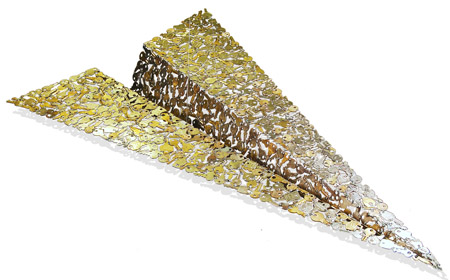
Really great sculptures made out of recycled material.

http://www.ndigallery.com/


The first one of keys on a paper airplane is by Brian Mock.

The second one of metal parts to make a giraffe is by Andrew Chase.

And the last one, one of my favorite assembling artists, is Leo Sewell. He uses a lot of random, founded junk to create his sculptures.


There's a list of artists within the website with some truly amazing pieces. They may not exactly be using materials for the kind of projects we'll be doing, but they may provide some great inspiration/ideas :)


*Update

Mark Langan would be a good one to look at for his artwork using cardboard.