Sunday, February 20, 2011

Marek's Reading Responses
I sure hope this is the right place!
Reading 1: Critique Handbook, Chapter 1
This reading discussed the basics of how to critique pretty much any work of art in an all-encompassing way. Paramount to the reading of objects is the intent of the artist- with the advent of abstract forms of expression that modernism brought and the explosion of new ideas and forms of post modernism, art can no longer be critiqued under a single rubric, the way that salon painting was in the 19th century. The reading focuses then not so much on how to judge a work based on criteria of quality, but to examine how a work will be read, and what are some of the fruitful and barren approaches for interpreting a work.
The basics of formal elements for painting and sculpture are discussed in significant depth. With regards to painting, not only are the more commonly discussed formal elements of 2d design noted (line, color, composition, etc) but elements more specific to painting are explored in depth- how the painting relates to the edges of the canvas, how the picture plane occupies space and how to tell when that occupation is meant to be a significant aspect of the work as opposed to an ignorable necessity, how a painting acts as not only an artifact but also as a memento of its own creation (and how an experienced viewer can plot the course of the painting's creation, and divine the mental state of the artist as they made the work), the scale of the work, and when to read a painting as a representation (mimesis) as opposed to a presentation (referent to itself).
For sculpture, similar elements are discussed- the silhouette of a work, how it appears from different angles, whether it has a clear front or back, the footprint of the work, how it breaks up the space and effects how the viewers can move around it, how it relates to gravity (especially when suspended), how the work is presented (pedestals and room-within-a-rooms, ala the frames of a painting) and when the presentation methods should be seen as a part of the work or simply as a practicality, the materials and processes that a work is created in and with, respectively, and when the material has been used to create an illusion of something else or is a referent to itself (similar to the representational / non-representational divide of painting), and others such concerns.
The reading hasn't inspired me per se yet, although I've only just finished it and haven't had a chance to digest it, but the knowledge of these concerns is always interesting to think about when brainstorming, and just having the vocabulary to think and talk about certain elements of a work makes a significant difference with where your attention will end up. I took Art 12- 2D concepts last semester and it was my first introduction to the formal elements of painting- I'd never had it broken down in such a clean and understandable way before, and since that class I'd been wondering about what the equivalents would be in other mediums- this reading finally sheds some light, for me, onto those analogues in spatial art.
Invites
Thanks
Shannon
Saturday, February 12, 2011
The Fine Art of Recycling
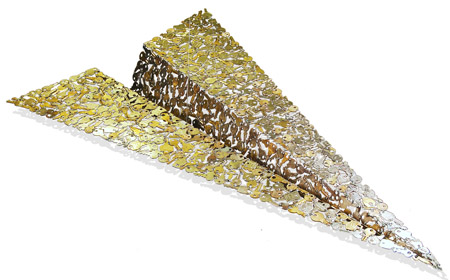


Really great sculptures made out of recycled material.
http://www.ndigallery.com/
The first one of keys on a paper airplane is by Brian Mock.
The second one of metal parts to make a giraffe is by Andrew Chase.
And the last one, one of my favorite assembling artists, is Leo Sewell. He uses a lot of random, founded junk to create his sculptures.
There's a list of artists within the website with some truly amazing pieces. They may not exactly be using materials for the kind of projects we'll be doing, but they may provide some great inspiration/ideas :)
*Update
Mark Langan would be a good one to look at for his artwork using cardboard.
Sunday, January 30, 2011
Former Student Projects.
 Dave Pennypacker, "Inner Child," 2007 (I think)
 Dave Pennypacker, "Inner Child," closeup
 Elizabeth Bowles, untitled. Bent-lamination using birch bending plywood. From my Woodworking For Sculpture class, Columbia College Chicago, 1998.
 Elizabeth Bowles, detail.


